

How Media Shapes Public Opinion—and Raises the Temperature in America

Something is changing in this country—and people can feel it, even if they can’t quite explain it.
Conversations escalate faster. Disagreements turn personal more quickly. The space between opposing views feels smaller, tighter, more volatile.
This didn’t happen overnight. And it didn’t happen in a vacuum.
Beneath the surface of daily headlines and viral clips, a powerful force is shaping not just what people think—but how they feel.
Media Doesn’t Just Report Reality—It Frames It

For decades, researchers in communication and psychology have reached a consistent conclusion: the media doesn’t simply present facts. It shapes perception.
Scholar Robert Entman, known for his work on framing theory, described media as selecting certain aspects of reality and making them more prominent.
Similarly, political scientist Shanto Iyengar demonstrated how presentation and emphasis influence how audiences assign responsibility and interpret events
It’s not just what is covered. It’s how it’s covered.
Tone. Word choice. Repetition. Emphasis.
These aren’t neutral decisions. They are emotional cues.
When coverage becomes consistently negative, highly personalized, or framed in extremes, it doesn’t just inform the public—it conditions the emotional response of the audience.
Why Negative Coverage Hits Harder
There’s a reason emotionally charged content spreads faster and sticks longer.

Psychological research, including the widely cited “Bad Is Stronger Than Good” principle, shows that negative information has a greater impact on the human brain than positive information.
Research in political communication, including work by Stuart Soroka, shows that Neg
Studies in political communication have also found that negative news draws more attention and engagement.
In practical terms, that means:
Negative framing is more memorable
Emotionally charged language is more persuasive
Repetition strengthens perception over time
When audiences are exposed to a steady stream of conflict-driven or alarm-based messaging, the result isn’t just awareness—it’s heightened emotional intensity.
The Line Between Criticism and Dehumanization
Criticism is a normal and necessary part of public discourse.
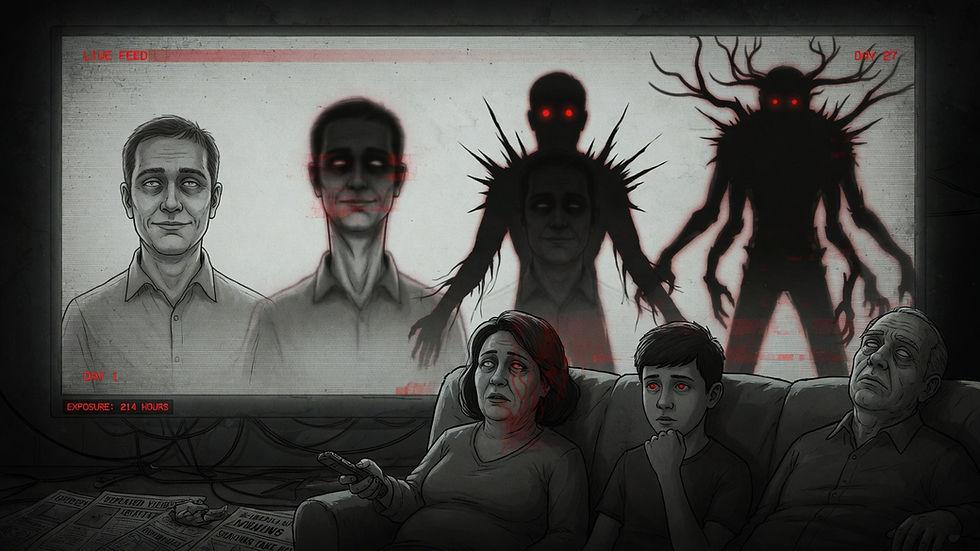
Dehumanization is something else entirely.
There is a line between the two—and that line is being crossed more often than many people realize.
Dehumanizing language doesn’t always appear extreme on the surface. It can take the form of repeated comparisons that frame individuals or groups as:
inherently dangerous
morally corrupt beyond redemption
subhuman or monstrous
existential threats to society
Research in social psychology, including work by Nick Haslam on dehumanization and studies by Lasana Harris and Susan Fiske demonstrating reduced empathy responses, has shown that dehumanizing language reduces empathy and increases hostility toward its targets.
The effect is gradual—but powerful.
When people are repeatedly portrayed not just as wrong, but as fundamentally less human, it becomes easier for audiences to justify anger, contempt, or social exclusion.
When Entertainment Becomes Reinforcement
The modern media environment is no longer neatly divided.

News, commentary, satire, and entertainment often exist side by side—sometimes within the same program.
Late-night shows, viral clips, and satirical commentary play a significant role in shaping public perception. Humor has always relied on exaggeration, but repetition changes its impact.
What begins as a joke can become a narrative.
What begins as exaggeration can feel like truth.
Over time, audiences absorb not just the humor—but the underlying framing.
The Collapse of Clear Boundaries
One of the most significant shifts in today’s media landscape is the erosion of clear distinctions between:
news reporting
analysis
opinion
entertainment
Research from the Pew Research Center has shown that many viewers struggle to consistently distinguish between factual reporting and opinion-based content.
When commentary is delivered with confidence—and reinforced through repetition—it can be internalized as fact, regardless of its original intent.
This creates a feedback loop:
Emotionally charged content draws attention
Audiences react and amplify it on social media
Media outlets report on those reactions
The cycle intensifies
Each pass through the cycle raises the emotional stakes.
Pew and other research show affective polarization (dislike of the opposing party) has risen sharply since the 1990s, with media consumption patterns correlating strongly.
Influence on Vulnerable Audiences
Most people can separate rhetoric from reality.
Some cannot.
Researchers have long warned about the potential impact of repeated, emotionally intense messaging on individuals who are already vulnerable, isolated, or struggling to interpret information clearly. Studies on media effects and aggression, including work summarized by the American Psychological Association, highlight how repeated exposure to certain types of content can influence perception and behavior patterns
This doesn’t mean media directly causes harmful actions. But it does mean that narratives—especially extreme ones—can shape how certain individuals understand the world around them.
When messaging consistently frames people or groups in absolute, dehumanizing terms, the risk is not just misunderstanding.
It’s distortion.
Why This Matters Now
The United States is already navigating a period of high tension.
Political divisions are sharp. Trust in institutions is low. Information moves faster than ever.
In that environment, the emotional tone of media matters.
Because:
Words shape perception.
Perception shapes emotion.
Emotion shapes behavior.
And behavior shapes the reality everyone has to live in.

The Question That Follows
This isn’t about limiting speech.
It’s about recognizing its impact.
The media has the power to inform, clarify, and challenge.
It also has the power to inflame, distort, and divide.
Acknowledgment starts with audiences demanding better, creators reflecting on incentives, and platforms rethinking engagement algorithms. The question is not whether that power exists. The question is whether we are willing to acknowledge how it’s being used—and what it is doing to the country in real time


Comments