

The Selfishness Of The Selfless Socialist
- Linda Genzel

- 26 minutes ago
- 4 min read
Linda Genzel
August 20 | Opinion
It will forever rank among life’s more consistently amusing ironies—not to mention, darkest punchlines—that the loudest champions of “wealth redistribution” are almost never the ones who earned a dime, much less broke a sweat creating any of it—unless you count the socialists’ habit of simply loading other people’s money onto pallets and calling the whole scheme “operation fairness.”
The fact is, the vast majority of these self-anointed moralists have neither built a business nor produced a single thing of genuine value that is worth redistributing—yet somehow they never tire of congratulating themselves for their boundless imaginary generosity as though the mere demand for a cut of someone else’s labor were the highest form of compassion.
They claim, of course, to be selfless social justice warriors, insisting that stripping the merited spoils from those who actually earned and deserve them constitutes the moral high ground. That particular twisted contradiction—the unproductive appointing themselves as the conscience of society while lecturing the productive on virtue—still refuses to compute in my brain.
There was a time—not so long ago—when we taught our children, openly and without apology or hesitation, that the urge to covet another kid’s toys or belongings was the textbook definition of selfishness: the shiny new bike in the neighbor’s driveway, the bigger piece of birthday cake when it wasn’t their birthday, the first-place ribbon pinned to someone else’s shirt, a ribbon someone else won fair and square. There was a simple, old-fashioned name for that impulse—greed, the intense and unabashed desire to take what was never yours to begin with. Easy enough for any child to remember: two E’s, listed for centuries among the deadly sins. No need for elaborate theories about class, no daydreams of a mythical “utopia,” and certainly no need for recitations of “from each according to his ability, to each according to his needs.”
Then later, when those same kids grew a little older, we handed them history books and, without sugar-coating, we let the record speak for itself: illustrating what happens the moment that same inherent selfish pathology—jealousy, possessiveness, that impulsive craving to take what others have produced—finally gets its hands on state power.

Time and again, across every generation and every domain of human existence and experience, socialist regimes and experiments ran the same predictable course, following the identical script with grim reliability: first, they began by dispossessing ordinary people of their private property under the banner of so-called fairness, along with seizing the means of production, and pie-in-the-sky promises of classless egalitarianism, then, finally they ended, inevitably, in collapse. The looters, the freshly minted elite now backed by and armed with the full coercive force of the Nanny State, either kept the spoils for themselves or parceled them out to their cronies—always and without exception, to the lasting detriment of the masses they pretended to champion.
For the vast majority of us, all of this—at least at one time or another—made perfect, almost instinctive sense, because the cosmos had already demonstrated the pattern with brutal, blood-soaked clarity: the strong create, the weaker circle and wait. That was—and still is, for those of us equipped with functioning brain cells—an ancient and stubborn observation deeply rooted in human nature itself. For every lion, a hyena. For every shark, a remora. Think of The Fountainhead by Ayn Rand: Howard Roark, the uncompromising, independent architect, a creator, who asked nothing of anyone, and Ellsworth Toohey, a parasitic newspaper columnist and consummate critic who hated him for it—a pair who still capture it perfectly: for every builder, a weaker scavenger, forever vindictive and nursing a permanent psychological grievance that fortune made him less capable.
This dynamic, this recurring pattern, transcends politics itself—it has appeared and continues to appear wherever honest efforts create something of value and resentment gathers and follows, biding its time, determined to claim a share of what it did not earn. It was only after our children were exposed to a particular strain of thinking, or more accurately put, after they entered the rarefied air of liberal academia, that the social-justice-warrior Marxist professors set out to achieve the great inversion. Their goal: to dupe our youth into believing that what we have always known to be true simply wasn’t so—declaring that the productive and the successful are the problem, the disease, while the envious and the dependent are somehow the cure.

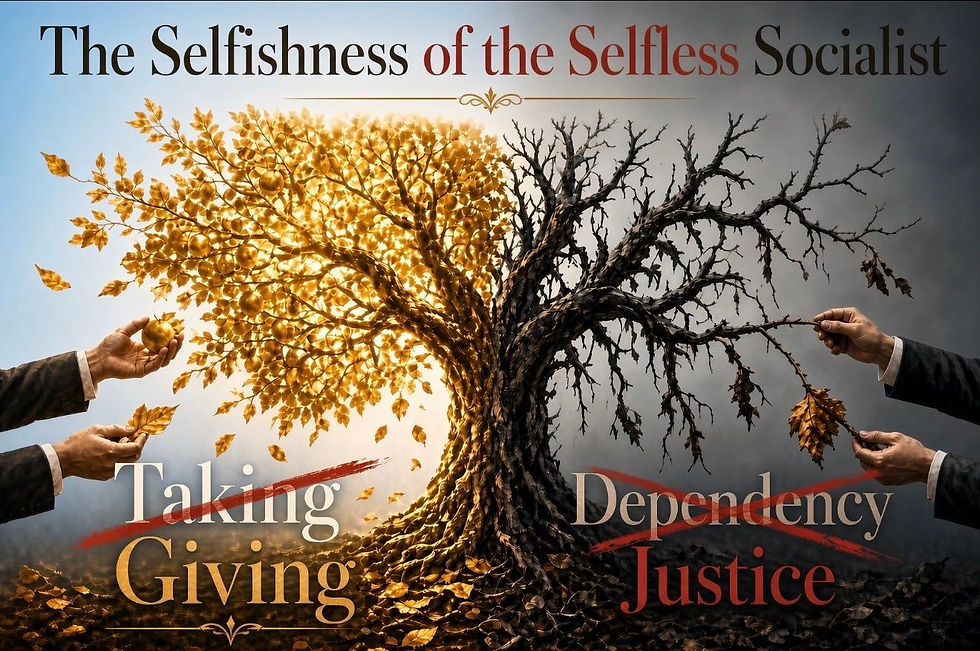
Of all people, New Yorkers, in particular, might want to consider sobering up and, for once, before it's too late, try rejecting the self-congratulatory intoxication of selfish Democrat-socialism—that familiar brew skillfully packaged in soft language, moral preening, and the endless promises that someone else will pay—sold as pure altruism and compassion. If not for their own sake, then, at the very least, for the sake of their children and grandchildren, who will otherwise grow up paying the price for a generation that chose to call taking “giving” and dependency “justice.” They will inherit the bill, the decay, and the diminished future—not the utopia that was promised, but the predictable wreckage that always follows when envy is mistaken for virtue and resentment is elevated to a governing principle.
Affordability is absolutely a problem. No serious person is denying that—the numbers don’t lie. However, that said, this is a crisis that was engineered, principally by the same big-government policies that, for decades, Progressive politicians offered up and continue to promote as the cure through expansive Democrat-Socialist spending, policies, and restrictive regulations that not only systematically punish production and reward dependency but also choke supply while inflating demand, making housing, energy, and everyday life deliberately more expensive.

The only proven corrective measure lies in the opposite direction: the restoration of production, the dismantling of artificial constraints, and the reassertion of genuine market incentives—the very capitalist policies championed and currently being implemented by President Trump and his administration that expand supply and, as a necessary consequence, exert downward pressure on prices.
Handing still more power to the very people who produce nothing is not compassion, and nor is it the solution. No matter how many which ways to Sunday or how cleverly it is branded, or moreover, rebranded, the solution will never be to give power to the leeches, to enlarge the class of people who live by taking from those who actually produce. That is not a path to relief. It is a proven recipe for deeper, more permanent disaster—one history has already written the ending of.
Linda Genzel Editor @WECU News
Opinion


Comments