

The Shot Heard Round the World: Defending the Republic Our Founders Built
- Linda Genzel

- Jul 6
- 8 min read
Updated: Jul 8


On June 7, 1776, Richard Henry Lee of Virginia stood before the Second Continental Congress in Philadelphia and introduced a bold resolution—referred to as the Lee Resolution—declaring: “That these United Colonies are, and of right ought to be, free and independent States, that they are absolved from all allegiance to the British Crown, and that all political connection between them and the State of Great Britain is, and ought to be, totally dissolved.”
By then, tension between the British Crown and the colonies had been building for over a decade, fueled by the pioneering resistance of the Sons of Liberty—a network of brave Freedom Fighters who, amongst many others throughout the colonies, included Samuel Adams, Paul Revere, John Hancock, Joseph Warren, Patrick Henry, Benjamin Rush, and others such as John Lamb, Alexander McDougall, Isaac Sears, James Otis, and Oliver Wolcott. These patriots organized protests and acts of defiance across the colonies—most famously the Boston Tea Party in December 1773.
However, by the spring of 1775, this resistance had escalated into open fighting, and on April 18, 1775, Dr. Joseph Warren—a Founding Father, a leading Son of Liberty, and president of the Massachusetts Provincial Congress—received intelligence through a network of patriot spies that British troops were amassing and preparing to march that night toward Concord to seize colonial weapons and supplies, and possibly arrest Adams and Hancock—both Sons of Liberty and later Founding Fathers.
Warren immediately dispatched Paul Revere and William Dawes to ride out that night and spread the alarm. In anticipation of such an ambush, as part of a prearranged plan, two lanterns were hung in the steeple of Boston’s Old North Church, signaling the route “by sea” the British were taking, thereby alerting the colonial watchers along the Charlestown shore, roughly 1 mile across the Charles River.
That was the night Paul Revere made his historic midnight ride to warn the colonists that the British were coming. He successfully warned Samuel Adams and John Hancock in Lexington, and, along the way, the colonial militia, known as the Minutemen—an elite subset of the broader colonial militia. However, later that night, he was captured by a British patrol, but by then, it was too late; the alarms had already been triggered, and other riders, including William Dawes and Samuel Prescott, continued spreading the word, so the militia was ready when the British arrived.
The next morning—April 19, 1775—British forces, infamously known as the Redcoats, first clashed with the Minutemen at Lexington Green. a few hours later, the more sustained fighting occurred at the North Bridge in Concord—the iconic battle that Ralph Waldo Emerson later immortalized with the phrase “The shot heard round the world.” This marked the beginning of the Revolutionary War that ultimately led to our Independence from Great Britain. In response, King George III declared the colonists to be in open rebellion.

In any case, even after the fight for independence and freedom had begun in 1775, some colonists and moderate leaders in the Second Continental Congress still hoped for reconciliation with the British Crown. Amongst them were John Dickinson, Robert Morris, Edward Rutledge, some New York delegates, such as James Duane, and a few others from Pennsylvania and Maryland.
These moderate delegates viewed themselves as loyal British subjects who simply wanted their rights as Englishmen to be respected—no taxation without representation and repeal of oppressive laws. They sent petitions to King George asking him to address their grievances while remaining part of the British Empire. Their most notable, and final, attempt or appeal for peace was referred to as the Olive Branch Petition of July 1775. It was drafted, primarily, by John Dickinson, as mentioned above—a leading moderate in the Second Continental Congress—who, along with his fellow Crown loyalists, believed the fighting might force Britain to negotiate fairer terms rather than lead to complete separation.
The King’s rejection of the Olive Branch Petition, combined with the Sons of Liberty’s continued hardline push for independence—particularly from Samuel Adams and John Hancock, both also Founding Fathers, who served as delegates in the Second Continental Congress—along with growing support boosted by Thomas Paine’s Common Sense in January 1776, finally shifted the balance by mid-1776. As a result, moderate delegates—meeting under strict secrecy—largely gave up hope of a peaceful joint resolution between the colonies and the Crown and all later supported the Declaration of Independence.
Suffice it to say, on June 7, 1776, Richard Henry Lee introduced the Lee Resolution that consisted of three parts:
1)— A formal Declaration of Independence.
2)— A call to pursue foreign alliances.
And
3)— A plan for confederation among the colonies.
The Continental Congress appointed committees to draft each element, including one led by Thomas Jefferson—one of the most important Founding Fathers and the principal author of the Declaration of Independence—to write a formal document explaining our decision to sever ties with the British Crown to the world.
Because some delegates believed the move was premature or lacked clear instructions from their provincial legislatures, the final vote was delayed until July 2, 1776—the day Congress approved the core independence section of Lee’s three-part resolution by a vote of twelve colonies to zero—with New York, the thirteenth colony, abstaining while awaiting word from home. This was the moment the colonies officially severed ties with Britain.
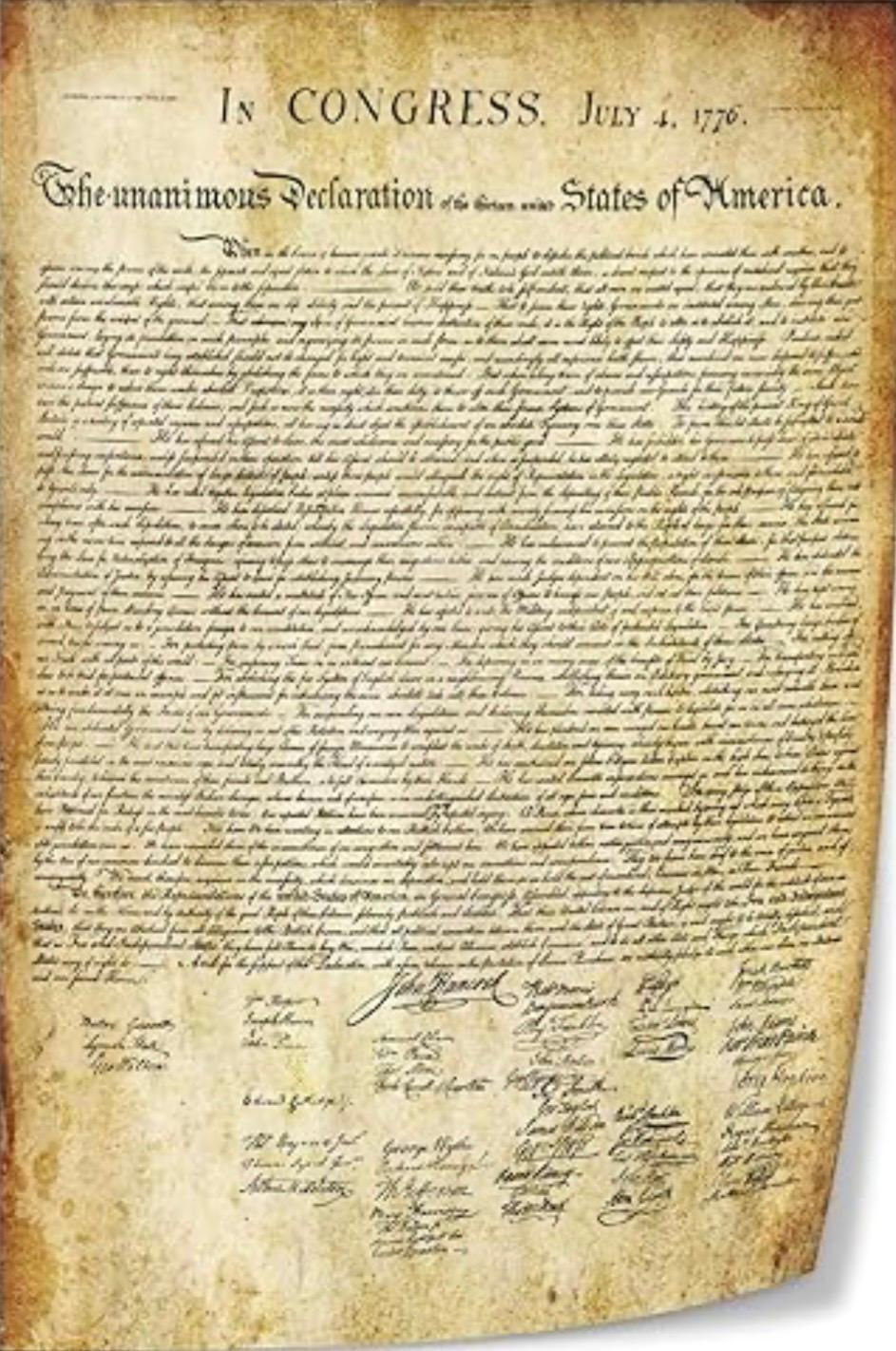
Two days later, on July 4, 1776, Congress approved the final text or draft of the Declaration of Independence—the eloquent document Jefferson primarily authored, which listed the colonists' grievances against King George III and justified the July 2 decision to part ways with the Crown. Contrary to popular belief, this was not the primary “signing day” per se. Most delegates affixed their signatures to the famous parchment on August 2, 1776, with others signing even later; however, July 4 was the official day the “final text” of the Declaration of Independence was approved and passed by Congress.
That said, despite officially passing, New York’s delegates did not vote for independence on either July 2 or July 4 as they still lacked authorization from home. However, on July 9, 1776, their provincial Congress voted to support independence, allowing its delegates to join the other twelve colonies. Only then could the Declaration of Independence be accurately described as the “unanimous” expression of the thirteen colonies.
As for the other two parts of the Lee Resolution, the plan for foreign alliances was adopted in September 1776, and the Articles of Confederation—the first framework for the union of states, or in this case colonies—were not finalized until November 1777.
The Sons of Liberty, together with the broader coalition of freedom fighters throughout the colonies and the 56 signers of the Declaration of Independence—our Founding Fathers—were all great men. In fact, several prominent Sons of Liberty, including John Hancock—whose famous bold signature on the Declaration was said to be intentionally written so large that King George could read it without his spectacles . . . or in less polite terms, as I would like to believe, inscribed in indelible ink as an everlasting middle finger to the British Crown—were themselves among our Founding Fathers whose bravery ushered in a great age of liberty with the birth of our Constitutional Republic.
The inception of any nation is, in and of itself, a significant moment in history, however, the founding of the United States stands as one of the most courageous, extraordinary, and improbable achievements the world has ever seen.
At the time, with a population of only about 2.5 million scattered across a vast, untamed wilderness, this young self-governing Republic faced overwhelming odds. The people were poor, military supplies were scarce, and there were no modern tools or means of communication or travel to coordinate and mobilize quickly if such a need arose, at least not like today, anyway—no telegraphs, no phones, no computers, no internet, no satellite, no vehicles, no nothing but a horse and saddle. Distances we could easily cross in a matter of hours took many long and treacherous days back then.

Yet in the face of these immense challenges and against the full might and scale of the British Empire, the Sons of Liberty and our Founding Fathers courageously chose the path of liberty and independence, and against all odds, they succeeded.
And so, you see, the Fourth of July is not just another holiday—it is so much more than that; it is the proud and triumphant beginning of our national story. And it should—at least for anyone with a conscience who believes in the principles of freedom and the right to determine their own path in life—stir in every American a deep sense of pride, patriotism, and gratitude.
The Declaration of Independence—the first and greatest pact in our Nation’s history—remains one of the most powerful and enduring expressions of human freedom ever written. It proclaims to the world “that all men are created equal, that they are endowed by their Creator with certain unalienable Rights, that among these are Life, Liberty and the pursuit of Happiness. That to secure these rights, Governments are instituted among Men, deriving their just powers from the consent of the governed.”
If our Republic is to endure, to remain free, we must stand firmly by and be true to these Principles because they are sacred, saving, and worth defending with everything we have—they are our nation’s moral foundation and guiding light.
Despite how viciously the Left has and continues to vilify them, the Sons of Liberty and our Founding Fathers were brave, red-blooded patriots and genuine heroes. They loved and placed the good of their country, this Republic, above their own comfort, safety, and self-interest. They pledged their lives, their fortunes, and their sacred honor for a cause far greater than themselves, placing the future of a free nation and her people above all else—a rare and admirable virtue that ought to command our everlasting respect. Anything less is a profound disservice to them and to all those who have since laid down their lives in service, defense, and protection of this Republic and her people.
The liberty they secured is our inheritance, and so it is our solemn responsibility to cherish, protect, and ensure it is passed on to the next generation.
Now is the time to stand and fight for that inheritance against the growing clear and present threat posed by foreign and domestic enemies in Congress who call themselves Democrat-Socialists but who are, in truth, at their very core, Communists who are not only embracing but successfully advancing tyrannical and theological ideologies rooted in Cultural Marxism, Fascism, and radical Islamism under the faux veil of social justice—working from within to ultimately and fundamentally transform our Republic and take away the very freedoms our Founding Fathers fought and died for.
We must rise with the same courage, conviction, and determination as those who came before us. We cannot passively stand by while these Communists systematically undermine our Constitution, steal our liberties, and dismantle our Republic.

Yes, it is imperative that we take the time to honor the memory and bravery of our Founding Fathers and all Freedom Fighters who have laid down their lives so we may be free. But, and particularly during these precarious times, we must commit ourselves—heart, mind, and strength—to defending our Constitutional Principles and God-given Unalienable Rights on all occasions, in all places, against all enemies, both foreign and domestic, at whatever cost. Only then can we ensure that this extraordinary Shining City on a Hill survives and continues to burn as a beacon of hope and freedom for the world for another 250 years.
Linda Genzel Editor @WECU News
Opinion.


Comments