

America's Manufacturing Renaissance: Learning from Europe's Warning
For decades, Western economies have wrestled with the shifting balance between industrial production and digital growth. As nations look to secure their supply chains against global volatility, the concept of America's manufacturing renaissance has moved from a policy ambition to an economic necessity, sparked by deep structural challenges observed across the Atlantic.
Europe's Shift to Services: A Cautionary Tale
For decades, Europe has prioritized services, finance, and a rapid green transition while allowing its foundational manufacturing base to shrink. According to World Bank and European Commission data, the manufacturing sector's share of EU GDP has atrophied from roughly 17.4% in 2000 to approximately 14% today. While countries like Germany anchored the continent's industrial core for longer, the compounding pressures of soaring energy costs, aggressive regulatory burdens, and systemic outsourcing have left the continent exposed.
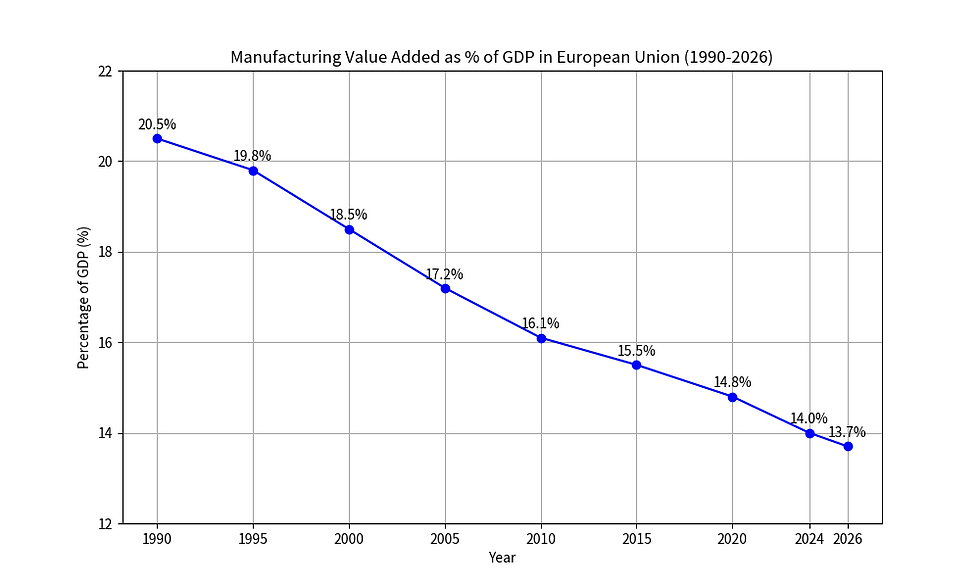
Industrial production remains stubbornly sluggish. Mid-2026 consensus forecasts have trimmed expected Eurozone GDP growth to a mere 0.8% to 1.0%, weighed down by persistent structural headwinds and energy import dependencies. While Europe actively debates reindustrialization—proposing measures like the Industrial Accelerator Act to streamline permitting—it continuously struggles against fragmented markets, uncompetitive power pricing, and a loss of supply-chain autonomy. The overarching result is clear: stagnating productivity, regional economic decline, and dangerous strategic dependencies laid bare by geopolitical and energy shocks. Europe isn’t entirely "lost," but its trajectory serves as an urgent warning about the perils of hollowing out core industrial capacity without robust domestic safeguards.
The US Opportunity: Rebuilding the Industrial Core
The United States is tracking a fundamentally different trajectory. Armed with vast domestic energy advantages, clear technological leadership, and greater policy agility, America is uniquely positioned to sustain its high-productivity service sector while aggressively rebuilding its strategic industrial commons. This is not a zero-sum choice; an advanced economy can, and should, do both. While a services-dominated economy drives immediate high-margin productivity, outsourcing the physical production of critical inputs exposes a nation to deep, systemic vulnerabilities.
Key Risks of Over-Outsourcing
Pharmaceuticals and Life-Saving Medicines: Over-reliance on foreign Active Pharmaceutical Ingredients (APIs) means that domestic public health safety is only as reliable as distant, often backlogged oversight allows. For years, rare unannounced inspections at foreign manufacturing sites have left the door open for quality control lapses, contamination scandals, and adulterated supply chains. National security, patient safety, and critical drug shortages hang in the balance when a nation cannot independently guarantee its own medical supply.
Steel and Industrial Infrastructure: Relying on heavily subsidized, subpar imported steel cascades hidden weaknesses directly into our cars, bridges, pipelines, and defense systems. Allowing the domestic steel ecosystem to wither doesn't just lose factories—it erodes the underlying "industrial commons," permanently scattering the specialized labor, local suppliers, and strict quality traceability required for national resilience.
The Solutions Playbook: Drivers of America's Manufacturing Renaissance
Momentum is accelerating through targeted, high-impact legislative and trade actions designed to secure domestic capacity and fuel America's manufacturing renaissance across multiple sectors.
1. Aggressive Trade Enforcement & Quality Safeguards
Pharmaceuticals: Under a pivotal April 2026 presidential proclamation leveraging Section 232 of the Trade Expansion Act, the US is implementing a 100% tariff on imports of covered patented pharmaceuticals and APIs, targeting non-generic drugs listed in the FDA's Orange and Purple books. To foster immediate reshoring, the policy utilizes a carrot-and-stick approach: companies can access a reduced 20% transitional tariff rate through early 2029 (or 0% by meeting specific Most-Favored-Nation pricing deals) if they secure an approved domestic onshoring plan with the Department of Commerce.
Steel: Enhanced trade enforcement and tariff adjustments have directly disincentivized underpriced, low-quality imports. This protection has yielded immediate domestic wins, such as U.S. Steel's April 2026 announcement to invest $15–$20 million to restart the Gary Tin Mill in early 2027, bringing back hundreds of jobs and securing domestic supply chains for food packaging and agricultural sectors.

FDA Oversight: Expanding on successful pilot programs, the FDA has scaled unannounced foreign facility inspections, forcing overseas plants to meet the same rigorous quality and sanitation standards applied to domestic manufacturers.
2. Incentives, Procurement, and Energy Policy
Replicating the successes of the CHIPS Act by introducing targeted federal frameworks to anchor domestic battery ecosystems and critical pharmaceutical manufacturing.
Strengthening "Buy American" mandates within infrastructure and defense procurement to ensure reliable, long-term demand for domestic mills and factories.
Implementing tax reforms featuring immediate expensing for advanced R&D and capital equipment alongside aggressive permitting reform to get domestic facilities online faster.
Capitalizing on America's abundant natural gas and expanding nuclear power potential to give domestic manufacturers a permanent, low-cost energy advantage over European and Asian competitors.
Adopting a dual-track sourcing philosophy: mandate absolute domestic production for high-risk national security items (medicines, defense-grade steel, microchips), while shifting secondary supply chains exclusively to reliable, allied "friend-shored" partners.
3. Technology Integration in America's Manufacturing Renaissance
A critical component of this industrial shift is the integration of advanced workplace technologies. Scaling modern apprenticeship models and community college technical programs is essential to rapidly train the next generation of advanced manufacturing workers. Furthermore, by leveraging artificial intelligence, advanced robotics, and high-tech automation, domestic facilities can offset labor cost differentials while significantly boosting manufacturing precision, output volume, and quality consistency.
The Bottom Line
Europe provides a vivid case study of what occurs when a superpower allows its industrial base to atrophy without a deliberate counter-strategy. The United States possesses the economic toolkit, the energy independence, and the political momentum to dodge this structural trap. By vigorously defending quality standards, penalizing predatory trade, and heavily investing in advanced domestic production, the groundwork for America's manufacturing renaissance is firmly established. This is not a nostalgic retreat into the past; it is the blueprint for a smart industrial strategy built for the future.



Comments