

Can a Business Legally Refuse to Serve You Over Your Politics? In Most of America, Yes.
A Brooklyn coffee shop's public ejection of a Jewish congressman this week highlights a little-known gap in federal civil rights law — and the critical legal line between political views and protected identity.
By WECU Media Staff
Most Americans assume that if a business is open to the public, it must serve the public — regardless of politics, opinions, or beliefs. A Brooklyn coffee shop made national headlines this week by proving that assumption wrong, and federal prosecutors are now testing just how far the law reaches.
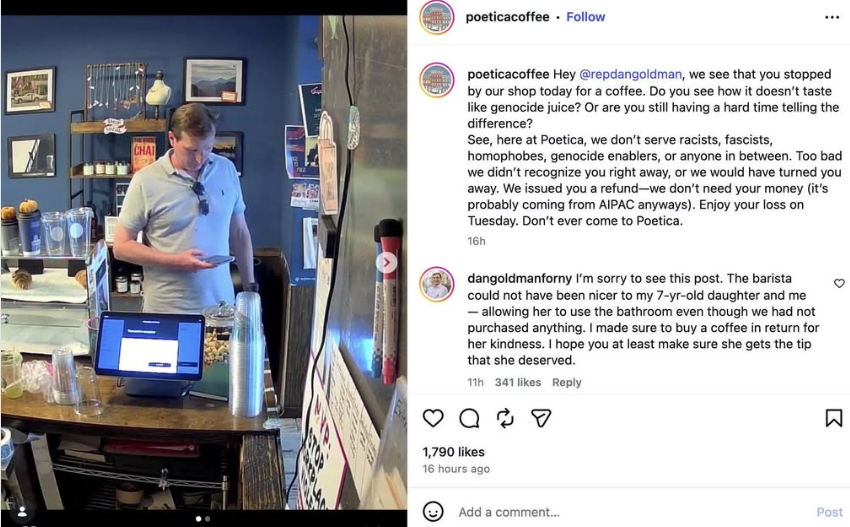
Poetica Coffee, a chain with seven locations across Brooklyn and Manhattan’s East Village, issued a public refund to Rep. Dan Goldman, D-N.Y., over the weekend after learning the Jewish congressman had stopped at its Williamsburg location with his young daughter. In a since-deleted social media post, the shop declared it did not serve “genocide enablers” — a reference to Goldman’s support for Israel — and stated it would have turned him away had it recognized him sooner.
The Department of Justice responded swiftly. Assistant Attorney General Harmeet Dhillon, who leads the Civil Rights Division, announced Monday that her office had opened a formal investigation. “These actions are not only reprehensible, they’re potentially illegal,” Dhillon wrote on social media, adding that enforcement action was possible. Goldman himself said he would prefer the DOJ focus its resources on antisemitism affecting people with less public standing.
Goldman said the interaction with the barista had been entirely cordial. “I had such a nice interaction with the barista,” he told CNN. “She was wearing a hijab, I didn’t know her, but she couldn’t have been nicer and allowed my daughter to go use the bathroom, and I honestly was so grateful for her kindness that I felt like I should buy a coffee.”
What the Law Says — and What It Doesn't
Under federal law, the legal picture is clear and limited. Title II of the Civil Rights Act of 1964 prohibits discrimination in public accommodations — restaurants, hotels, shops, and similar businesses — based on race, color, religion, or national origin. Political beliefs are not a protected class under federal law. Most states follow the same framework.
That means a business owner can, in most of the country, legally refuse service to a customer over support for Israel, opposition to Israel, support for former President Trump, or virtually any other political or ideological position — without violating federal anti-discrimination statutes. Private businesses retain their own First Amendment rights to free speech and association.
A small number of jurisdictions — including Washington, D.C., Seattle, and parts of California — have enacted local ordinances that extend protection to certain political activities or affiliations. But those are narrow exceptions to the national rule.
Where the Line Gets Complicated
The critical legal question is whether a refusal framed as “political” actually masks discrimination based on a protected characteristic. Courts examine intent, not just stated rationale.
That distinction is precisely why the Poetica case drew federal scrutiny. Mark Treyger, chief executive of the Jewish Community Relations Council of New York, argued that the shop’s conduct “absolutely violates New York’s human rights laws.” He said: “Assigning collective blame to Jews or perceived supporters of Israel over disagreements with Middle East policies is the very definition of antisemitism. Turning a cup of coffee into a Jewish identity litmus test is an affront to the law, our values, and every New Yorker who rejects discrimination.”
Mark Goldfeder, director of the National Jewish Advocacy Center, noted that the shop’s post “gave the game away” by conspiratorially referencing the American Israel Public Affairs Committee. “They put a huge amount of Jewish people on notice that they are not welcome,” Goldfeder said. “It’s not just about Dan Goldman. It puts a lot of Jews on edge.”
A Pattern of Federal Enforcement
The Poetica investigation follows a lawsuit the DOJ filed in June 2025 against the Jerusalem Coffee House in Oakland, California — a case that illustrates how the political-versus-religious line can collapse in practice.
According to the federal complaint, owner Fathi Abdulrahim Harara on two separate occasions ordered Jewish customers wearing Star of David baseball caps to leave the premises. In one incident, an employee told a customer: “You’re the guy with the hat. You’re the Jew. You’re the Zionist. We don’t want you in our coffee shop. Get out.” In another, Harara confronted a Jewish man who had entered with his five-year-old son, demanding to know whether he was a “Zionist” before ejecting him and calling the boy’s father a “dog.”
The DOJ argued the ejections violated Title II, regardless of how the owner characterized his motive. Harara’s attorney denied the allegations, calling the lawsuit a political stunt aimed at silencing voices for Palestinian rights. The case is pending in U.S. District Court for the Northern District of California.
A Phenomenon That Runs in Both Directions
Politically motivated service refusals are not new, and they do not belong to one side of the political divide. During the Trump administration, several high-profile incidents involved restaurants asking administration officials or MAGA-hat-wearing customers to leave. Some businesses posted explicit policies refusing service to Trump supporters. Legal challenges in those cases similarly turned on whether the refusal concealed discrimination based on race, national origin, or religion.
Legal analysts say the current wave of anti-Israel or anti-Zionism incidents is more prominent in progressive urban areas, a reflection of the Israel-Gaza conflict’s dominance in the cultural conversation. The earlier wave of anti-conservative refusals emerged when those views were more salient in national discourse. The pattern, observers note, follows whatever issue drives the news cycle — and businesses tend to act more boldly when their views align with the dominant sentiment of their local community.
The Real Check Is the Market, Not the Courts
Even when refusals of service are legally permissible, they carry real-world costs. Boycotts, negative reviews, and public backlash have followed businesses on both sides of the political spectrum after high-profile incidents. Poetica Coffee deleted its Instagram account following the Goldman episode. Brad Lander, Goldman’s Democratic primary opponent, broke with the shop: “There are plenty of ways to lobby elected officials and express outrage at the votes they’ve taken without turning coffee shops into places people don’t feel welcome.”
Poetica’s own published ethos declares that “whoever walks through the door is treated with unconditional dignity” and that every visitor “deserves to be welcomed.” Staff declined to elaborate on the apparent contradiction, saying only: “We stand against genocide.”
The Bottom Line
In America, a coffee shop can legally choose its customers based on politics — in most states and under federal law. What it cannot do, in most jurisdictions, is use politics as a pretext for discrimination based on race, religion, or national origin. As the Poetica and Jerusalem Coffee House cases make clear, that line is increasingly contested, and federal prosecutors are watching.
Whether the broader practice is healthy for a pluralistic society is a question the law leaves to the marketplace — and to public opinion.
— WECU Media | wecumedia.com


Business owners need to understand the legal responsibilities that come with serving customers, including applicable anti discrimination rules and local regulations. Anyone considering business setup in UAE should also research the licensing requirements and legal framework that apply to their chosen activity before starting operations. Having a clear understanding of these obligations can help businesses make informed decisions and build trust with a diverse customer base.