

Iran’s Terror Empire: Proxies, Blood, Oil Money, and the Global Hypocrisy That Keeps It Alive -Part 1
The Full Picture

Since 1979 the Islamic Republic of Iran has not been just another country in the Middle East. It has been a funding machine for terrorism — the single largest state sponsor on Earth. Through its Islamic Revolutionary Guard Corps-Quds Force (IRGC-QF), Tehran has poured billions in oil revenue into an “Axis of Resistance” designed to bleed its enemies without ever fighting them directly. The strategy is brilliant in its cynicism: let others die for your revolution.
Here is the machine, the blood it has spilled, the neighbors who tried to stop it, the recent U.S.-Israeli strikes that finally tried to break it, and the chorus of outrage that followed — led by the very powers who invaded Ukraine.
The Funding Machine
Iran’s oil exports — 1.5 to 1.8 million barrels per day, mostly to China via shadow fleets — generate tens of billions annually despite sanctions. A huge slice goes straight to the IRGC. U.S. Treasury and intelligence assessments put annual proxy spending in the hundreds of millions to low billions. Cash, weapons, training, and IRGC commanders flow to five main networks.
The Proxies and the Blood on Their Hands
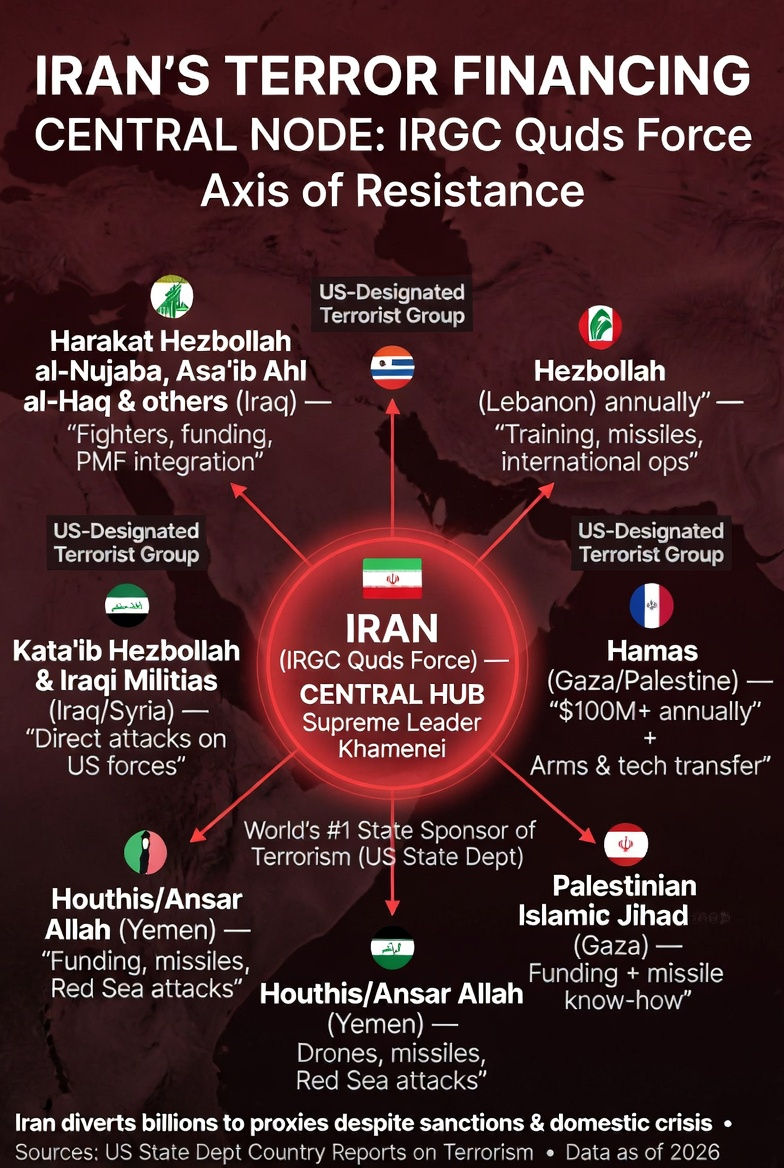
Hezbollah (Lebanon)
– Iran’s crown jewel, $700 million to $1 billion+ per year.Responsible for: 1983 Beirut Marine barracks bombing (241 U.S. dead), 1983 U.S. Embassy bombing (63 dead), 1994 AMIA bombing in Argentina (85 dead), 1996 Khobar Towers (19 U.S. airmen), thousands of rockets on Israeli civilians, and the 2006 war.
Hamas & Palestinian Islamic Jihad (Gaza)
– $80–350 million per year from Iran.October 7, 2023 massacre: 1,200 Israelis and foreigners slaughtered (46 Americans), 251 hostages. Decades of suicide bombings, bus attacks, and rocket barrages that turned civilian life in southern Israel into a nightmare.
Houthis (Yemen)
– $100–300 million plus advanced weapons and IRGC advisors.Hundreds of drone and missile attacks on commercial shipping in the Red Sea (2023–2026), killing seafarers and crippling global trade. Direct strikes on Israel and U.S. naval forces.
Iraqi militias (Kata’ib Hezbollah, Asa’ib Ahl al-Haq, etc.)
– IRGC salaries, weapons, direction.Hundreds of attacks on U.S. bases, including the January 2024 Jordan drone strike that killed three American troops. Ongoing campaigns that wounded dozens more with traumatic brain injuries.
Syrian proxies & Assad-era network
– Iran spent $16–50 billion propping up Assad.Enabled barrel-bombing, chemical attacks, and mass civilian slaughter in the Syrian civil war. Thousands dead. Billions in damage. All underwritten by Iranian oil.
Iran’s Real Reason
Tehran’s leaders call it “resistance against oppression.” The real reason is cold strategy: forward defense. Proxies keep the fight on someone else’s soil. They give Iran plausible deniability, cheap asymmetric power, and a “ring of fire” around Israel and U.S. interests. The ideology is the sales pitch; regime survival and regional hegemony are the product.
Middle Eastern Countries Did Not Sit Idle
Saudi Arabia and the UAE led a nine-year coalition war in Yemen, bombing Houthi positions and interdicting Iranian weapons shipments. They still back local anti-Houthi forces and joined U.S. naval operations against Red Sea attacks.
The Gulf Cooperation Council designated Hezbollah a terrorist group in 2016 and froze its financiers’ assets across the region.
Israel has conducted thousands of airstrikes on Iranian targets in Syria, assassinated IRGC commanders, and directly degraded Hezbollah and Hamas capabilities.
Jordan, Egypt, and Iraq have all taken steps — from border control to blocking militia launches — to limit the spread. Post-Assad Syria (late 2024) saw Iran’s entire network there collapse almost overnight.
These countries know exactly who Iran is. They have fought its proxies in blood and treasure for years.

The 2026 U.S.-Israeli Strikes: Finally Breaking the Chain
In February-March 2026, with Iran’s nuclear breakout time shrinking and proxies re-arming, the United States and Israel launched pre-emptive strikes on nuclear sites, IRGC command centers, and proxy infrastructure. Khamenei is dead. The nuclear program is set back years. Hezbollah and Hamas are degraded. The Syrian proxy network is gone. Iraqi militias were largely told to stand down by Baghdad.
It was not pretty. Civilian casualties occurred. Oil prices spiked. Iranian retaliation hit Gulf states and U.S. bases. But the alternative — a nuclear-armed Iran directing the same terror groups — was judged far worse.
The Global Pushback — and the Hypocrisy That Powered It
The United Nations Secretary-General António Guterres condemned the strikes immediately. Russia and China called them “unprovoked aggression” and “violation of sovereignty.” Turkey warned of a “circle of fire.” Parts of Europe wrung their hands about “unilateralism” and “squandered diplomacy.”
Russia — the country that launched a full-scale invasion of Ukraine in 2022, annexed territory, and is still trying to erase a sovereign nation after three years of war — lectured the world about “territorial integrity.”
China — which has threatened Taiwan with military force for decades — suddenly became a champion of non-interference when its Iranian partner was hit.
The same powers that block every tough UN resolution on Iran’s nuclear program and proxies suddenly discovered the sacredness of borders. The same Russia that vetoes anything meaningful on Iran while committing war crimes in Ukraine now cries foul when someone else acts.
That is the hypocrisy in plain sight.
Why the Pushback Persists Even When Everyone Knows Iran Is the Problem
UN Charter technicalities and veto math make legal approval impossible.
Genuine fear of wider war, refugee waves, and oil shocks.
Domestic politics and anti-American reflexes in parts of Europe and the Arab street.
Great-power rivalry: Russia and China use Iran as a proxy to bleed American power.
None of it changes the facts on the ground: Iran built the terror machine. Its oil money keeps it running. Its proxies have American, Israeli, Arab, and civilian blood on their hands. And when someone finally tried to dismantle the machine, the loudest complainers were the very regimes that practice the same aggression elsewhere.
This is the full picture.
The proxies, the funding, the body count, the regional resistance, the desperate necessity of the 2026 strikes, and the selective outrage that still shields Tehran.
We are just getting started. We have the spine. We have the receipts. We have the receipts on the hypocrisy, too.
Chapter 2:
The Nuclear Wildcard – Why Pre-Emption Was the Only Realistic Option
(The Threshold That Could Have Changed Everything)
Chapter 1 laid bare Iran's terror empire: the proxies, the funding from oil billions, the body counts from Beirut to October 7, the regional pushback from Gulf states and Israel, the UN's paralysis, and the glaring hypocrisy from Russia and China. But the strikes in February-March 2026 weren't just about dismantling a funding machine for terrorism. They were about stopping a far deadlier escalation: an Iran that crosses the nuclear threshold while its proxies remain armed and active.

Iran does not have a nuclear weapon in March 2026. U.S. intelligence, IAEA assessments, and independent experts confirm no structured weaponization program exists. No bomb has been built. But the program was never truly "obliterated" despite repeated claims. The June 2025 U.S.-Israeli strikes (Operation Midnight Hammer) severely damaged key enrichment sites (Natanz, Fordow, Isfahan), destroyed centrifuges, and scattered stockpiles. Breakout time—the period to produce enough weapons-grade uranium for one bomb—stretched from days/weeks pre-2025 to months or "frozen" post-strikes, per IAEA Director General Rafael Grossi and analysts. Iran retained ~400 kg of 60% enriched uranium (enough for several devices if further processed), with its exact location unknown—possibly hidden underground or dispersed.
By early 2026, Iran showed signs of rebuilding: satellite imagery revealed reconstruction at damaged sites, hardened bunkers (e.g., Taleghan 2 at Parchin for explosive testing linked to past weaponization), and covert moves to protect remaining material. Indirect talks in Oman (mediated February 2026) made progress but stalled—Iran refused to dismantle key facilities or end enrichment entirely. U.S. officials assessed Tehran was reconstituting pathways, with missiles capable of reaching U.S. bases (and potentially farther), advancing in parallel.
The Trump administration's rationale crystallized: preemption to prevent an "imminent" rebuild. President Trump stated Iran was "attempting to rebuild" and posed threats via missiles and proxies. Defense Secretary Pete Hegseth framed Operation Epic Fury as destroying missile production, naval forces, and ensuring "Iran will never have nuclear weapons." A senior official claimed intelligence showed Iran planning pre-emptive missile launches against U.S./Israeli targets. Critics (Arms Control Association, some IAEA statements) noted no evidence of active weaponization or immediate breakout—Grossi said "no" to days/weeks away from a bomb. Yet the administration viewed latency + proxies + missiles as intolerable: a nuclear Iran directing Hezbollah rockets, Houthi drones, or Iraqi militia attacks would be catastrophic.
The Nightmare Scenario: A Nuclear Weapon in Proxy Hands?
Even if Iran assembled a crude device (gun-type or implosion, 500–1,000+ kg, detectable radiation signature), experts across think tanks (CSIS, Wilson Center, Arms Control Association) assess transfer to proxies as highly unlikely and logistically nightmarish—almost suicidal for the regime.
Technical barriers: A bomb requires shock-proof transport, constant monitoring, secure custody to prevent premature detonation/theft. Radiation detectable by sensors (ports, borders, satellites). No proxy has the expertise for arming/maintenance.
Timelines (hypothetical, if attempted):
Hezbollah: Fastest—1–4 weeks overland via Iraq/Syria remnants. But post-2025/2026 degradations (Hezbollah weakened, Syrian network collapsed) make routes vulnerable to Israeli interdiction.
Iraqi militias: Days to weeks—direct border hand-off. But groups are semi-integrated into Iraqi state; less "off-leash."
Houthis: 3–8 weeks—sea smuggling via dhows (how missiles/drones move). U.S./coalition naval patrols in Red Sea/Indian Ocean make interception probable.
Hamas: Months—tunnels/smuggling via Egypt/Sinai. Near-impossible without detection.
In every case, IRGC minders, heavy security, and evasion tactics would scream "high-value movement." U.S./Israeli/Gulf intelligence would detect it fast. Loss of command-and-control (proxy could use independently) triggers massive retaliation—wiping out Tehran.
Proliferation experts are unanimous: A nuke is regime survival insurance. Handing it to a proxy erases deniability, invites annihilation. Iran prefers latency for deterrence, not proliferation. Proxies bleed enemies cheaply; a bomb ends that game.
Why Pre-Emption, Not Patience?
Waiting meant risking:
Shortened breakout (hidden uranium + rebuilt centrifuges).
Missiles reaching U.S. bases/Europe.
Proxies emboldened under nuclear umbrella (Hezbollah rockets, Houthi shipping attacks, Iraqi militia strikes—all amplified).
Strikes set back the program years: entrances damaged at Natanz, covert sites hit (Minzadehei, Parchin/Taleghan 2), missile production degraded. Khamenei dead, IRGC command fractured. No radiological release, per IAEA. But knowledge persists—decentralized, mature program can't be erased like Osirak (1981).
Pre-emption wasn't ideal—civilian risks, oil shocks, escalation fears. But diplomacy stalled, UN vetoes blocked multilateral action, and containment failed for decades. The strikes bought time against the ultimate red line: nuclear Iran directing its terror network.
The wildcard remains: If Iran rebuilds underground, hides material, or seeks surrogate nukes (e.g., North Korea ties), the cycle restarts. But 2026 proved force can delay—perhaps long enough for regime change or new leadership.
Chapter 3:
The Morning After – Fallout, Fury, and the Sudden “Peace” Brigade
The dust hadn’t even settled over the smoking ruins of Natanz and Fordow when the real-world consequences hit. The February–March 2026 U.S.-Israeli strikes didn’t just damage buildings — they shattered Iran’s carefully built illusion of untouchability. Khamenei was dead. The IRGC command structure was fractured. The nuclear program was set back years. And for the first time since 1979, the regime looked mortal.
Inside Iran the regime scrambled. Hardliners and pragmatists fought behind closed doors over succession while the IRGC, operating on pre-planned decentralized orders, unleashed a barrage of retaliation: more than 500 ballistic missiles and 2,000+ drones aimed at Israel, U.S. bases, and Gulf targets. Civilian areas took hits. Airports in the UAE, Bahrain, and Kuwait closed temporarily. Oil facilities in Saudi Arabia and Iraq were struck. Tehran tried to project strength, but the Axis of Resistance that Iran had spent billions building suddenly looked brittle.
Hezbollah, already gutted from prior fighting, fired fewer rockets than expected. Iraqi militias launched some attacks but were quickly reined in by Baghdad — many simply went quiet. The Houthis kept lobbing drones at shipping but lost their most advanced Iranian-supplied systems. The Syrian proxy network? Already collapsed after Assad’s fall. The funding machine was still coughing up cash, but the command-and-control that made the proxies lethal had taken a direct hit. The dominoes didn’t fall overnight, but they were visibly cracking.
Economically, the world felt the tremor. Oil spiked above $110 a barrel in the first week as the Strait of Hormuz saw panic shipping halts. Global markets shuddered. European and Asian airlines rerouted around the region. Inflation fears rippled through every gas pump from California to Berlin. The very countries that had spent years warning against “escalation” were now paying the price for decades of letting Iran’s terror economy run unchecked.
And then came the hypocrisy that should surprise exactly no one.
Back in the United States, the usual suspects — certain Democrats in Congress, legacy media voices, and the professional outrage machine — suddenly discovered their principles. They took to the airwaves and social media to denounce the strikes as “illegal aggression,” “disproportionate,” and a “dangerous escalation.” They wailed about civilian casualties and “squandered diplomacy” as though they had spent the last 15 years blissfully unaware that the IRGC was funding Hezbollah’s suicide bombings, Hamas’s massacre of 1,200 people on October 7, the Houthis’ Red Sea piracy, and Iraqi militias killing American troops. As if the intelligence briefings on Iran’s sprint toward nuclear breakout time had never crossed their desks. As if the same regime that cheered “Death to America” for decades hadn’t just been caught aspiring to bring that death a little closer to home.
Because here’s the blip that should have silenced every critic: In late February 2026 — right before the strikes — the FBI sent urgent bulletins to California law enforcement warning that Iran “aspired to conduct a surprise attack using unmanned aerial vehicles from an unidentified vessel off the coast of the United States homeland, specifically against unspecified targets in California.” Unverified? Yes. Technically insane given current drone ranges? Absolutely — Iran’s Shahed drones top out at roughly 1,200 miles, not the 7,000+ needed from Iranian waters. But the aspiration itself was real. A regime already arming proxies to kill Americans and Israelis was now dreaming of ship-launched drones hitting the West Coast. That is the threat the nitwits pretended didn’t exist until the moment someone finally did something about it.
The Gulf states took the retaliation on the chin — airports damaged, oil facilities struck — but many officials privately admitted the strikes bought them breathing room. Saudi Arabia and the UAE had fought the Houthis for years. Israel had been living under the shadow of Iranian missiles for decades. They knew the cost of inaction far better than the Monday-morning quarterbacks in Washington.
Russia and China, of course, howled the loudest — the same Russia still occupying chunks of Ukraine, the same China threatening Taiwan — lecturing the world about “sovereignty” and “international law.” The UN passed toothless resolutions. Europe issued statements. And the regime in Tehran limped forward, bloodied but not yet broken.
The strikes were never going to be clean. They weren’t supposed to be. They were a desperate, necessary correction after years of half-measures, failed deals, and willful blindness. The price was paid in blood, oil prices, and diplomatic capital. But the alternative — a nuclear Iran directing an intact terror network with Hezbollah rockets, Houthi missiles, and Iraqi drones — would have been infinitely worse.
The machine is damaged. The proxies are weaker. The nuclear wildcard is delayed. And the world finally saw what happens when someone stops pretending the problem will solve itself.
Conclusion
Iran’s terror empire was never invincible. It was expensive, fragile, and built on a foundation of oil money, plausible deniability, and global hesitation. The 2026 strikes exposed every crack: the proxies that folded when the funding tap tightened, the neighbors who had been fighting Iran’s war by proxy for years, the great-power hypocrisy that protects aggressors until it’s inconvenient, and the domestic voices that only find their conscience when America acts.
This wasn’t about regime change for its own sake. It was about survival — for Israel, for the Gulf, for American troops, and ultimately for the idea that a nuclear terror sponsor cannot be allowed to cross the final threshold.
The story isn’t over. Iran still has oil. The IRGC still has networks. The proxies still breathe. But for the first time in decades, the machine is stuttering. The dominoes are wobbling. And the world can no longer claim it didn’t see them coming.
The receipts are below. Read them. Then decide who was really on the side of history.
References: (For the nitwits who will inevitably call us liars)
U.S. Department of State – Country Reports on Terrorism (annual editions 2018–2025) – Iran designated leading state sponsor; proxy funding and attack attributions.
U.S. Department of the Treasury – Sanctions announcements on IRGC-QF, Hezbollah, Hamas, Houthis, Kata’ib Hezbollah (multiple years through 2026).
Wilson Center & Washington Institute for Near East Policy – Reports on “Axis of Resistance” funding estimates ($700M–$1B+ to Hezbollah; $100M+ to Hamas/PIJ; $100–300M to Houthis).
Council on Foreign Relations (CFR) – Backgrounders on Iranian proxy strategy and $16–50B spent on Assad/Syria.
ABC News / FBI Bulletin (February 2026) – Warning to California law enforcement on Iran’s aspirational drone attack from vessel off U.S. West Coast.
U.S. Intelligence Community Assessments (2025–2026) – Iranian nuclear breakout timelines, missile/drone capabilities, and post-strike damage reports.
New York Post & Fox News (March 2026) – Coverage of FBI West Coast drone alert and expert assessments.
U.S. Energy Information Administration & market reports – Oil revenue figures and 2026 price spikes post-strikes.
U.N. Security Council records & statements (2026) – Russian/Chinese condemnations and veto history on Iran measures.
Arms Control Association & IAEA reports – Pre- and post-strike nuclear program status (no weapon built; program damaged but knowledge intact).


Comments